Showing posts with label beginner. Show all posts

10/14/2014

exam

As a teacher, you get to know myriads of different types and kinds of people. It is your job to understand them, adjust to them, and learn to handle them. This, however, doesn't mean that you are not challenged, or occasionally even shocked, by them. A couple of months ago I told you about a major cultural shock I had with one of my students. Remember, the Chinese invasion. Besides the shocking behavioral culture, they surprised me with the expected outcome of the tutoring. The parents had set their minds to put the child in an English-speaking school from September, so he was supposed to master English, to pass an entrance exam, from zero, in two months. I occasionally think of the kid and wonder how he might be doing. I really liked him, but more emphatically I felt sorry for him for the domineering parents. After such cases I find myself concluding that it is so much harder to teach kids than adults, for two apparent reasons. On the one hand, with children, it is the parents who order and evaluate your service -- without being present and being realistic about the needs and abilities of the child. This can lead to false expectations and conflicts between the teacher and the parent, the teacher and the child, and maybe even between the child and the parent. On the other hand, when teaching kids -- who tend to be much more open and much less shielded than adults -- you get a very intimate insight into the family picture. More often than not, you notice deficiencies in that picture, but you have little space and limited rights to interfere. You may ask, you may comment, you may advise, but there is no recipe whether and how much you should involve yourself or accept; fight or leave; or something inbetween.


But then, I often realize adults are not much simpler either. I recently started to teach a young woman in her 30s who wanted to pass an exam in order to get a raise in her workplace. She came to me when she already had failed two exams. When I got into the picture, she had 1-2 months left till the last exam of the year. On the first occasion, I learned that she was planning to take a specialized exam for medical staff. While this made sense in theory (she being a nurse), when confronted with the specific exam tasks, I firmly believed it was a no-go. Although it was supposed to be intermediate, let's say B1, the reading was so difficult that even I had to check some of the vocabulary to comprehend the message. As for her, she practically didn't get anything out of it. At the end of the session, I tried to convince her to rethink her schedule, in order to spare herself another disappointment. She said she would think about it. For two weeks we were practicing these horribly complicated medical texts. She was progressing, getting more and more confident, but the goal was still way too far. 

After two weeks she informed me that she had changed her mind about the exam. She wouldn't take the one we were practicing for, because she didn't feel confident. She would try another one, a regular, which had an exam date one month later than we had calculated. I supported her decision. We started to practice more "real-life" English, not just the vocabulary drilling the previous exam required, and it was also a pleasant change that we had much more time to digest the material. I started to see some light at the end of the tunnel. 

But then came another twist. Next time we met, she told me she had third thoughts. She went back to believing that the medical exam would be more useful, so we needed to return to that. Four weeks were left. And then she had some family trip so we didn't have classes. And then we had classes but she started to panic so that's why we couldn't progress. And then... and then...
...and then came the exam.


The dilemma is the same in both cases. How much you care. You have to be a parent, a guide, a friend, a police officer, a therapist, an encyclopedia, Google Translate, and, at the same time, yourself. Finding the balance between connection and distance is the exam we, teachers, have to learn to pass.

7/21/2014

duolingo

True to the motto of this blog, let me present you another aspect of how every student (and individual) is unique in both how they function and what they need. Many people turn to me with questions regarding language learning techniques. Some emphasize that they need constant supervision and personal contact to keep themselves motivated. They are the ones that come to have classes with me. Some of these people point out that they prefer to have some coursebook and workbook, so they can keep track of their development. Others, however, are bored of language books; for them I prepare individual materials. There are those who demand home work and those who oppose to it. Another, all the more significant, group is looking to find e-learning tools, which can either function as a complement to guided learning (like group or individual classes) or it can even be the way: something they can apply for their own needs, in their own tempo, with their own supervision.

Let us see one such tool in more detail. Duolingo is gaining more and more popularity in Hungary. It is free, it offers extensive English exercises in Hungarian, and if you already speak English, you can learn German, Italian, Dutch, Spanish, Polish, Russian, Turkish, Danish, and Swedish, among others. Naturally, the fact that it was advertised in a free, daily newspaper of ours also contributed to its success. But how does it work?

After an easy and user-friendly registration, you will find yourself on a pleasantly designed and well structured site. Once you pick the language you wish to master, the course begins with a welcome test. The practice is split up into different levels and you can advance only if you manage to solve the exercises with less than 3 mistakes. Your development (as far as levels are concerned) is illustrated on a vertical scale, while your daily performance (measured in Lingot points) is visualized on a graph.


If, say, you want to practice prepositions, the system divides them into smaller chapters focusing on 4-5 items at one time. The tasks include translations, first from English to Hungarian, so the learner gets familar with the meanings. Then the Hungarian sentences need to be turned into English, so the learner becomes able to produce the meanings as well. Then, the same sentences and phrases, with occasional mild alterations, are brought to oral comprehension: the uttered sentences need to be written by the learner. This way pronunciation and spelling are coupled.


The system always gives feedback about the learner's production. If the solution was incorrect, the correct one is provided. At this point I must point out some obvious shortcomings. Even on the elementary level, with simple sentences, I bumped into problematic cases of what is correct and what is not. Occasionally, the system is very (even unnecessarily) strict, while other times it is inconsistent. Why this is frustrating is because once you collect 3 failures, you need to return and start over.


To compensate the rigidity of the system, Duolingo built in a message board, which makes it possible for the language learning community to comment on every task. The above sentence was, for example, widely discussed. Even if it seems a pain in the ass to go back and start the exercise again, it can give you some comfort if you see others found it problematic or unfair as well.


As we see, Duolingo's e-learning system offers a lot, but to stay realistic, it's not flawless. Why I do find it worth trying is because it applies many characteristics of community learning. Not only does it try to give you feedback on your progress -- like a teacher -- but it also creates the feeling of being part of a community -- like a language group. In short, it endeavors to combine the advantages of individual learning (doing it when you want, as frequently as you want, where you want) and the benefits of community learning (doing it with supervisors and peers, in short, with people). To see how it fits your specific needs, give it a (Lin)go.

7/15/2014

chinatown

Recently I had a clearly extraordinary experience both professionally and culturally. I was contacted by a Chinese woman whose friend's child, a teenager, wanted English classes. That fact that her English in the email was understandable but very awkward (and I figured, she must be the one that speaks the best English, which is why it was her that wrote to me not the parents) should have been a wrong omen. Even more so, because when we spoke on the phone to arrange a personal meeting, she wanted to change to Hungarian, as something she spoke better. Chinese are known to have this very specific accent when it comes to speaking European languages that few natives understand. Unfortunately I wasn't among those few. It was a real challenge even to agree on the place and time to meet. But then I still thought I liked challenges.


The next day I found myself in a café with a jury of 6 Chinese staring at me. They were very nice and offered to buy me a tea, and then the negotiations started. The first question they made was whether I speak Chinese. Of course the question is valid, but it was a long shot. Then, they were wondering how I was planning to teach the boy who speaks no Hungarian, nor English. Well, to be honest, I had no idea the boy had no prior knowledge, given that I was informed he wants preparation for an all-English high school. I figured, that means a weak intermediate level, at least. Despite my surprise, I managed to wing it, explaining that with pictures, videos, and demonstrations it is not impossible. Surprisingly I convinced both my future clients and myself. The next question of the committee was where the classes could be and whether it was possible to have them at my place. As I confirmed, they went on with the interrogation: how big is my apartment, who lives there with me, what is his or her gender, etc. In my complete surprise, I kept answering but felt rather  puzzled where this would lead. Finally, they spat it out: they wanted the boy to stay with me for the nights as well, kind of like at a boarding school. I was speechless. To try to convince me, they kept repeating: money was not a problem. I felt as if being in some dream: I was offered a job which would make me filthy rich if I was willing to swallow a definite amount of awkwardness. I didn't give an answer then; we only arranged the first session of classes for the next day.


I was very stressed as I was preparing for the lessons. Never before was I faced with such a challenge that I need to teach someone without any common language. I realized, it was an added difficulty that he was Asian, probably not even knowing the Latin alphabet, which for us Europeans is at least a sound basis. It took me at least 4-5 hours to think of the tasks, find out bridging tools, and build a structure to a class (or rather three classes one after another) which I couldn't even imagine how it would go. 

Finally, the hour came, and the real difficulties arose from something I hadn't thought. They didn't know where my place was (despite the fact that the previous day they seemed to know, and I even sent them the address), so they called me on the phone three times for instructions, but neither of us got what the other said; it was a mess. Finally, they made it arriving 30 minutes late. But once we could get down to business, the class itself went very good! He indeed didn't know much English, had problems with the alphabet and writing, but his pronunciation and his will to learn was impressive. After two hours, we started to bond and like each other. I felt triumphant and proud to have met my challenge.


Then, the twist came. I got a call 45 minutes before the end of the class. It was one of the Chinese. I didn't get anything of what she was saying, so I gave the phone to the boy. It turned out the woman was standing in front of the door and I needed to let her in. She brought lunch. I was puzzled why she came at that moment. Was the class over? Otherwise how did she imagine she just comes and interrupts? There was no clear communication to me. In 10 minutes, the whole family arrived and invaded the apartment while speaking over my head in Chinese. I felt undescibably awkward, uncomfortable, and helpless. 6 people spread in my personal space and I had no control. At one point, the one that kind of spoke English said they wanted to stay for the last 30 minutes. I said, it was not a good idea. They still wanted and I still opposed. Eventually, the parents left and the "interpreter" stayed. It was still uncomfortable because she was sitting behind my back, either talking to the boy in Chinese, or laying down on my couch, or walking in my flat. I couldn't concentrate neither on him, nor on her. At the end I just wanted them out.

Overwhelmed by the whole experince and thinking that we mutually didn't like each other (I mean, with the student-teacher interaction there was no problem, but that's the least important factor when it is the parents who are the clients), I let go of the idea of getting rich. Amazingly, the next day they texted me at 8 AM that they are brining the boy in an hour. "No way", I said. When they asked if the next day was OK, I decided to give them another chance. In the evening, though, they cancelled, which was the end of the story. It turned out that they went to France. I figure, they sensed I am not the one that was going to board their child and they wanted him badly to learn English in just a couple of months. Money (and the child's comfort) didn't matter, so they just wanted to find a host, wherever.


To say the least, it was a tremendous culture shock for which I didn't even have to leave my home.

6/17/2014

this goodbye

Last time I wrote you how my kid learner and I said goodbye to each other for the summer. Well, actually that turned out to be not a real goodbye, as she asked for another class before the vacation. I was moved that she convinced the parents to meet me one more time. As a matter of fact, I also was planning, because we always end bigger blocks with a conclusive poster, which is what I was preparing for the end as well. That class when the parents suddently told me this was the last, I still wasn't ready to deliver the closing collage project, so it felt awkward for me too to wave goodbye like this. But anyway, we won over the parents for a decent pre-vacation project: yay!

Every time we created something in class -- and it was almost always -- I took a photo of it. Not just for future reference, but also for future use. For these closing lessons, I always print some of these art projects of ours and build exercises around them, so we recall them both as learning experiences and as creative experiences. She can contemplate and comment on the material we learned and on the feelings their production triggered. I must say, it was very rewarding to do this last poster with her, because she kept saying how much she liked this and that. She picked at least 4-5 favorites. As far as language learning is concerned, we went through the alphabet, the numbers, the seasons and months, school subjects, clothing, sports, animals, and some cultural events like Saint Patrick's Day, Christmas, or Halloween. So far little grammar was introduced, because at this age she is not yet familiar with grammatical terms in her mother tongue either. 


At the end of the class, then, she gave me a chocolate she fancies ("Merci"), with a hand-written letter:

Dear Anna,
Thank you for teaching me.
Whit (sic) love,
L.

It was just adorable. Then she asked me if I am going to be stricter next year. ;-)

3/11/2014

chai

Share a tea with me, my blog keeps saying. Well, it is not just a virtual invitation, at least in a certain amount of cases. Some of my students have the privilege to share and enjoy a real cup of tea with me, instead of the cyber tea parties I am organizing for you, rest of the world. Sometimes I serve herbal teas (chamomile is good for the belly, mint is refreshing and helps digestion, lemongrass calms your nerves, and the list could go on). Other times we have black tea, like Earl Grey or English Breakfast, to pay tribute to Britain, a tea giant and an English-speaking civilization. Occasionally, we take an Oriental trip to China or Japan, for some non-native adventure, and sip green tea, such as gunpowder or sencha. Last time, however, I thought of trying something less popular and well-known: I made us some Indian spicy-milky chai.

I searched the web and found a bunch of youtube videos about how to make this delicious beverage. I figured, why not kill two birds with one stone? Not only did I use the video as instructions for making the tea for the class, but I also incorporated it into the lesson plan. I prepared a warm-up task (jotting the ingredients and the instructions on small pieces of paper) and made a guessing-listening exercise, just to lead to the ecstatic moment of tasting the chai itself.


As always, I served the tea in the beginning but I didn't introduce or comment it. We just started the class with the planned warm-up. My student had to guess, based on the ingredients (like ginger, milk, cardamom, etc.), what it might be for. He felt it was some kind of tea but wasn't sure. Then, to get closer to the solution, we moved on to the instructions. He had to put the different steps of its preparation into order. More or less he got it right. Afterwards, we watched an authentic video, made by an Indian woman, to check how much his guesses were adequate. 


Finally, when the instructions became clear, he finalized his visual collage about "how to make chai". As a true reward, we could complete the exercise by even tasting and enjoying what we learned about.

1/28/2014

blind side

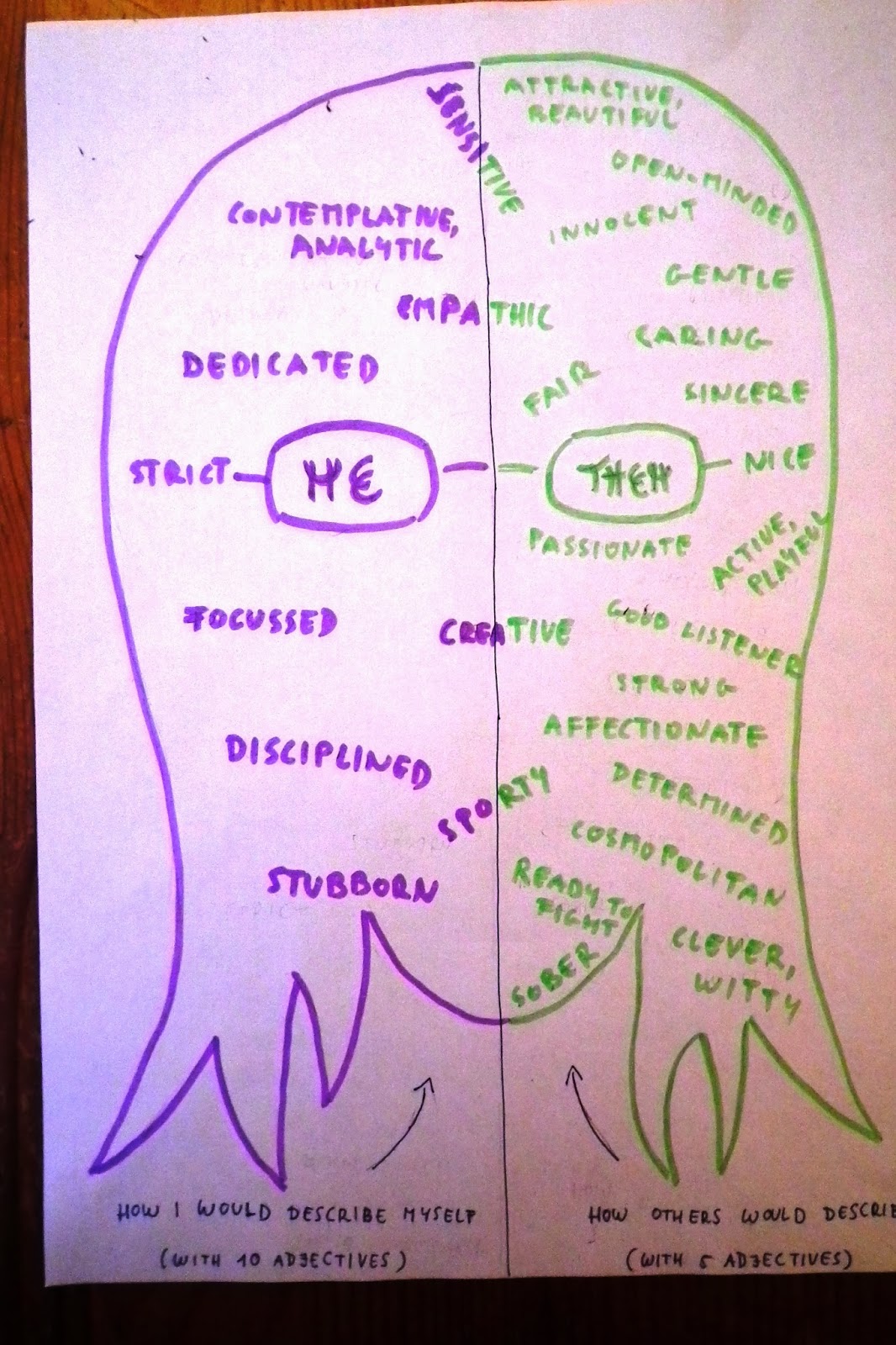
Let us return to the exciting experiment I presented to you last week. As a practice of adjectives and pronouns, my beginner student had to collect 10 attributes that he felt describe him the most, for one. For two, he also had to ask at least 3 other people to list some adjectives they found fitting for him. The atrributes, then, needed to go on the appropriate side of the face (the left was reserved for his self-description, while the right was the space dedicated for the opinions of the others).


Just to give you a short evaluation about his experiences, the student reported to have enjoyed the home assignment, because -- not only did he learn new vocabulary -- he had fun with his colleagues and friends. All in all, he said the majority of the qualities others considered characteristic of him were in line with his own perception of himself. (Although it was funny how someone described him as lazy, whereas someone else called him meticulous, orderly, and tidy -- slightly contradictorily.)

But instead of going into an analysis of his figure, keeping his personal rights safe, I thought I would give some feedback on mine. Last week I filled out the "me" side and asked you to provide me with the "them" side. Your comments were highly appreciated, as they proved to be useful not only for the class but also for my self-consciousness. Observe the results:


(I know, I know. The head looks like an octopus.)

There were 4 adjectives that both me and you (them) found characteristic (sensitive, empathic, creative, and sporty). Almost all of the qualities listed on the right side I could agree with and, if I had more space, I would have included. (What was maybe a bit surprising was cosmopolitan -- here I would be happy about some explanation :-). All in all, however, the biggest lesson lay in the comparison of what type of qualities I considered to be my first and most characteristic features and what others considered them to be. I mostly chose what I labeled hard "individualistic" qualities, in connection with mental capacities and willpower (analytic and dedicated), while others saw me much more as someone whose soft "interpersonal" qualities are more emphatic (gentle and caring).


If you check the figure above, you will find the shared adjectives in white, my descriptions in yellow, and those of the others in orange (creative and analytic, right? :-). Although it is obvious the perspectives are different (me observing myself from the inside, while others through interactions, that is, from the outside), the distribution of the colors says a great deal. 

I must conclude, you helped me find my soft spot... or blind side.

1/21/2014

me and them

New year -- new meetings. I have a new student, a beginner, or rather, a re-beginner. We have just started, so we are now in the exciting period of getting to know each other. As usual, I began with some self-introduction (his reaction to my prezume was, as expected: he appreciated it, admitting that visuals helped a great deal in filling his gaps to understand the talk). In the form of a game, tailored for his level, he was also made to share his -- initial -- thoughts about himself. 

Today, I felt, we could move on, both in digging out his forgotten English knowledge and in going deeper into a mutual opening up. I designed a game for him, in which pronouns, already refreshed in class, and adjectives, just introduced, could be practiced, while contemplating on something we are most interested in: ourselves.


He was expected to collect 10-15 adjectives that best describe himself and list them in the left side of the face. Then, in order to fill the right part of the face, he needed to ask 3 acquaintances to name 5-5 adjectives they think describe him the most. Of course, this game has not only linguistic but also psychological relevance.

Instead of revealing his answers, let me test the game on myself. Here are the adjectives I gathered about myself.


I am looking forward to filling the right side; so comments, with the 5 adjectives, are welcome.

12/10/2013

i learned all this

At the end of the year, I like to summarize what we have done -- what material we have practiced and what skills we have developed. The goal is two-fold: I find it both effective and rewarding, for the student and for the teacher, to see the steps of progress.

What I did with my kid learner was that I collected the works of art we produced in the preceding months, took a photo of them, and designed some tasks connected to each. This way, we spent some time with appreciating the piece of art, while also refreshing and practicing the knowledge we had acquired during the creative process.


 My student was very enthusiastic about the summative-reflective manual work -- until I made an unfortunate decision and told her that I have a Christmas surprise for her. From that moment, she couldn't wait to get over and done with the before-so-exciting summary, so she can succumb to the overpowering curiosity that only a child (or a genius) can have. 

To put a fair end to the story, I also reflected on what I had learned: I learned, when with children, to speak as little as possible. :-)

11/26/2013

creativity?

Creativity is a crucial element in my life. It is as much my antidote to boredom and monotonicity, as it is my expression of vitality and presence. I cannot imagine teaching, or more generally, human relations, to survive without it. However, I had to realize that, even though this statement may hold true, what creativity means for the specific person or group of people is not self-evident. 

With children I tend to experience that creativity means handicraft, involving drawing, coloring, cutting, gluing, assembling, and so on, which must bring a tangible result -- a piece of art to take home.

For academic people, may they be students or professors, it is much more verbal production that is the safe manifestation of creativity. Debating challenging topics or writing dialogues and short essays functions as the canvas for them to express their intellectual power and creativity.


The toughest cookie, as far as creativity is concerned, seems to be the business environment. Accepting that it is a far too broad category, I still feel like grouping office jobs together, because, no matter what the specific topic and field is, they are quite standard in their expectation, and in the implications, of sticking the employees to their chairs for 8 hours. In such circumstances, the language teacher needs to be cautious with too much of creativity imposed on workers who, outside of the classes, are required much more to bear and conduct monotonous tasks. With business English students, what seemed to work is the variation of activities, each involving just a little bit of creativity, so to keep them within their comfort zones but to bring some color into the office black-and-white.

It also happened that someone just couldn't tolerate any extent of creativity. He refused to engage in pair assignments, situational tasks, or discussions involving personal opinion, let alone in the creation of his visual resume. I must say, I was struggling with him for a month until I managed to reconcile the group's needs, my expectations, and the dynamics of the class with his comfort zone. I don't intend to imply that he was wrong; he was just the exception, in that group. And it's a piercing dilemma how to "leave no man behind" but to satisfy the needs of the majority.

11/18/2013

pro

Pronunciation is an important part of language learning. You have mastered a language if you manage to express yourself in a way that the majority understands you. With English, used as a common but foreign language by millions of people, it is tricky to decide what guidelines to follow when teaching pronunciation.


Do you pick one of the most dominant English-speaking cultures, say British or American? But then why not Irish, Canadian, Australian, South African, Nigerian, Indian, and the list could go on. Or do you expose the student to the dominant accent of the culture he/she will need to use the language in, say German English? Since for most students the destination is not this clear-cut or exclusive, do you choose to use different Englishes, giving up on a uniform, standardized input? Either way, it remains a dilemma, and most probably you will need to adjust the material to the needs of the specific student(s), while of course you won't be able to change your own (acquired, inherited, chosen, preferred) dialect. Or could you?

Check out this guy and be amazed by the variety of how English can sound and still be English.


Any preference?

11/16/2013

guess who

The other day I had a funny incident with my adult learner. It is not only its specificity and comic value that I decided to share it for, but also because it felt to me to be a general manifestation of our globalized society. So here's the thing. The class was focused on the practice of prepositions and numbers. At some point I introduced an exercise in which the particular linguistic units were embedded in a list of sentences referring to one person. After identifying the numbers and the prepositions in the phrases, she had to guess the subject of the sentences. The first set was about a notorious Hungarian celebrity, known for accidentally shooting himself to death and for earning the honorable title of the world's ugliest woman. The second set of sentences referred to one of the learner's acquaintances, someone she used to meet several times a week and just saw a couple of days before.

 
Can you guess how it went? She immediately knew the first one. With the second, however, she was seriously struggling. I had to confirm several times that she did know this person.


Were the questions wrong?* Or does she know a person she never met better than someone she played, laughed, cried with? Or is she not the exception but the rule, because we tend to spend more time, paying more attention to Twitter and Facebook than to our neighbor, sister, mother?


* Actually, I even made a mistake in the first description, as Zámbó Jimmy died, not, like I wrote, around 2004, but in 2001. But still, she was not misled.

11/02/2013

from mentor mob to lesson paths

As the third useful site, let's see what LessonPaths (ex-MentorMob, http://www.lessonpaths.com/) can do for us. Like Pinterest and Scoop.it!, LessonPaths helps you gather and share online content into themed folders. What is more here, you can edit them into a playlist. After each step, let's say, track, you can pose a test question, to check if your students got the point, or simply to poke and entertain them before the next assignment. 


I put together a selection of talks for an academic course on presentation skills, but business learners were also interested in going through a public speech development. Even if you are neither, I bet you'll profit from giving it a go. Let educator Ken Robinson, entrepreneur Steve Jobs, and "magic pixie" Brene Brown take you on a journey of inspiration!

10/19/2013

once upon a time

In an extraordinary context, even the most boring task can be fun. Imagine having to practice the holy transformation of affirmative into negative and interrogative. Imagine an adult learner that has difficulties adopting to new knowledge and is stuck on failure. What do you do? 

What I did was blindfolding her and taking her into wonderland. She found herself in the middle of a tale -- an eagle talking to a fox -- which was so fantastic that she forgot to worry and started to enjoy. This is the story she made up between a certain Ms Eagle and a naughty boy named Foxy.


10/07/2013

the four seasons

My kid learner is always super enthusiastic about handicraft. If she can cut, glue, stick, or draw, that's heaven (for adults, it tends to be burning hell). The other day, however, I must admit I screwed up: I allowed her to draw her family as an appetizer to an exercise. Well, let's just say, we didn't see much of the main dish that day.

So, having learned from this, I have tried to design the tasks so they engage the kid's creativity but within boundaries, set by the given time frame. Last time, for example, we were covering the four seasons. I brought her a tree, which had parts of each season, and made it into a jigsaw puzzle. First, she needed to put them back together and write the names of the seasons to the appropriate quarter. Then, we went through the months, practicing the alphabet and spelling. Finally, she had to think of what she likes about each season,  scribble it on a post-it, and stick it onto the picture. 
 

By the end, we had a rather cute composition and we managed to produce it in one sitting. With children I find it emphatically important to have a proper ending (after the main dish, or even better, after the dessert), so they can digest it more easily.


10/05/2013

scoop.it: a scoop of chocolate for me, please

To continue with online curation tools, let us now turn to Scoop.it! (www.scoop.it). Similar to Pinterest, Scoop.it! offers free registration. Once you added it to your browser, you can categorize, curate, and comment online materials, including text. Based on your key words of interest, it sends you a daily selection of various online content, scooped by others. 


I like Scoop.it! too, using it parallel to Pinterest. The tagging here is an advantage; though it doesn't always work as you would expect. Well, naming is quite subjective, isn't it?

Take a peek at my Visual Resumes folder. I just love visual resumes; they are imaginative, to-the-point, and convincing. Wouldn't it be useful for us, educators, to consider making a visual resume, instead of the boring CVs? Aren't we supposed to be creative? And so we are!

9/30/2013

the child in us

My beginner adult learner is progressing nicely. I realized not only is she motivated but she is also diligent. To keep her going, all I need to provide is enjoyable and simple tasks. Irregulars and "but"s don't work with her competence (she is not used to learning) and for her goal (in 2 months only survival, not perfection, can be the realistic aim). So, I started thinking: what would kids like doing? Pictures, colors, manual activity. Every time we need to practice a certain structure, I try to place it in some visual context, for example.


This above was an intro to the use of "be", which, in our native language is practically non-existent; therefore, it needs repeated clarifications and drilling. With the first pictures, she was still hesitant, but by the end she amused herself with the handsomeness of the fish.

9/23/2013

a way out

I started to coach an adult who wanted to acquire basic English in two months, so she could change jobs. She was highly motivated (she wanted to leave her job badly and language competence was a must in the other position) but she had serious difficulties with focusing and learning new things. Never before have I encountered such severe problems with the comprehension of basic things, so in the first couple of classes we were struggling. At one point, just when I saw her eyes were getting watery, I instinctively changed strategies and gave her the small, colorful cards I noticed next to me, which I use with my kid learners. Her face brightened up and in this creative process she forgot about worrying about the deadline and her disbelief in herself. Next class I made her a creative colorful task about pronouns: she had to put them in the right order, column, and color, then she was asked to indicate each pronoun she finds in the example sentences with the appropriate color. Slowly she started to see the point and by the third class she climbed the mountain that had seemed out of reach: she learned the pronouns.


We still have a long way to go but we are on the right track. At the end of the day, some of us only seem to have grown up; we are but children.

9/14/2013

pinterest: pin your interests

As a teacher, one needs to be handy with online tools, because it is impossible to be always creating; you need to get comfortable with curating as well. One great tool is Pinterest (www.pinterest.com). It is simple, practical, and social. Once you registered and added the red icon of the pin to your browser (as a Chrome application for example), all for free, you can start creating boards, let's say, folders, of your interest, and then, you can start collecting your pins, let's say, visual files, from the internet. They can be images, animations, talks, films, etc. (though not documents). By doing so, you can sort your materials and keep them in one place; and what's more, you can check other people's collections and pin them, that is, add to your own.
Check out my boards. You may find stuff you like.


Teaser: I have a nice collection of some inspirational TED talks on education. Well yeah, who doesn't know Ken Robinson's hilarious talk? But do you know Rita Pierson or Tyler DeWitt? You'll love 'em!


9/12/2013

a good start

I got a 10-year-old kid for private tutoring because her parents felt her school classes were not sufficient enough. In 2 years, they basically didn't practice anything but coloring their notebook. She was my first kid learner, so I went by instinct not by experience. We started with creating the alphabet: she had to write the letters on colorful stickers, glue them on the sheet, collect words with the letters she already knows, then glue pictures next to the appropriate letter.


By the end, she realized she did know quite a few English words; she learned to say the alphabet which she hadn't known before; and she made herself a fancy board to take home and practice the words from. When waving me goodbye after the class, she said she wished school classes were this much fun. (As for me, I felt to say I wished all my students were this enthusiastic and honest -- but I didn't say it. Because I am like most of my students: adult = reserved and polite.)

And next week she told me the ABC by heart.